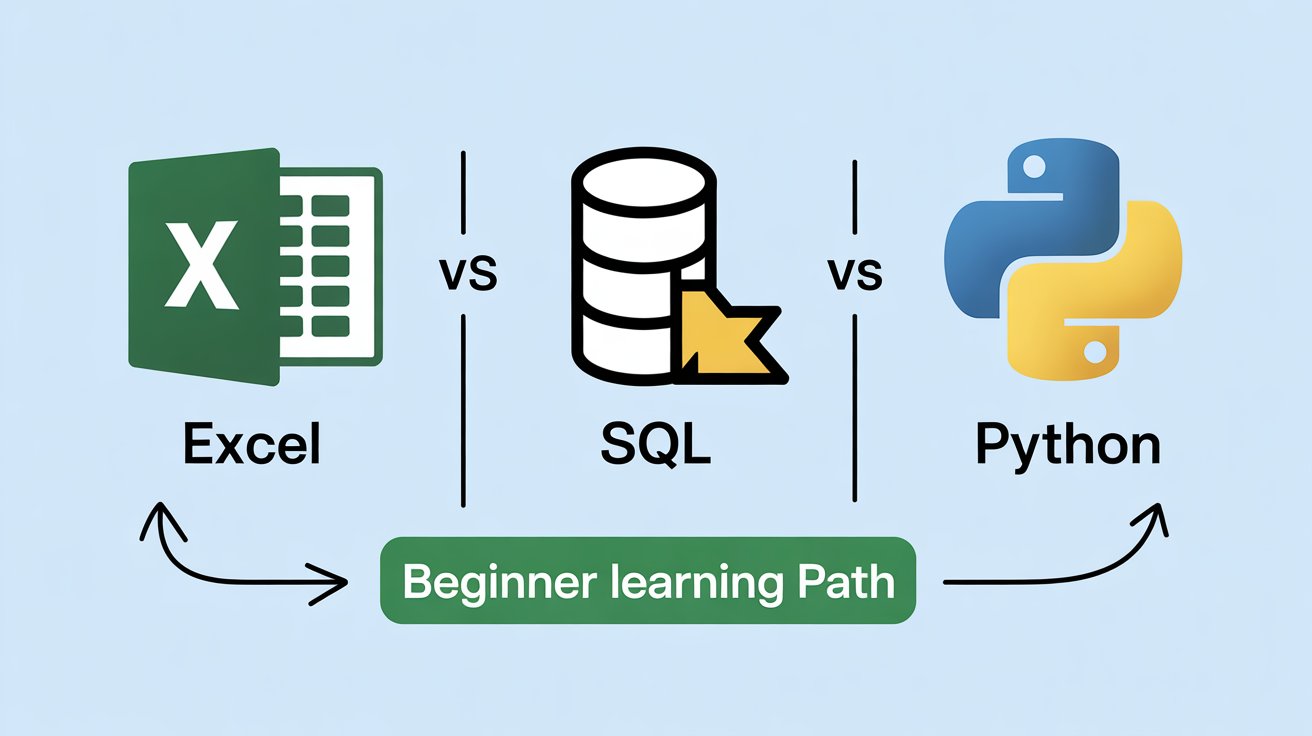
If you’re starting a career in data analytics, one of the most common questions you’ll encounter is:
Should I learn SQL, Excel, or Python first?
Each of these tools plays a critical role in the data analytics ecosystem, and all three appear frequently in junior data analyst job descriptions. However, learning them in the right order can significantly improve your employability, confidence, and speed of growth.
This guide compares SQL vs Excel vs Python from a beginner’s perspective and helps you decide what to learn first—and why.
Why This Question Matters for Beginners
Entry-level data analysts are not expected to master every tool. Employers typically look for:
-
Strong fundamentals
-
Ability to work with data
-
Practical problem-solving skills
Choosing the right starting tool helps you:
-
Build confidence quickly
-
Create job-ready projects
-
Qualify for junior analyst roles faster.
Let’s break down each tool and its relevance for beginners.
Excel: The Best Starting Point for Absolute Beginners
Why Excel Is Beginner-Friendly
Excel is often the first tool used in data-related roles, including business analysis, operations, finance, and analytics.
Key advantages:
-
Minimal learning curve
-
Visual interface
-
Widely used across industries.
-
No coding required
What Beginners Learn with Excel
-
Data cleaning (removing duplicates, formatting)
-
Sorting and filtering datasets
-
Basic formulas (SUM, AVERAGE, IF, VLOOKUP/XLOOKUP)
-
Pivot tables and charts
-
Basic dashboards
Limitations of Excel
-
Not ideal for large datasets
-
Limited automation
-
Not scalable for complex analytics
Verdict:
Excel is an excellent first step for understanding data concepts, but it should not be your final destination.
SQL: The Most Important Skill for Entry-Level Data Analysts
Why SQL Is Critical
SQL (Structured Query Language) is used to retrieve and manipulate data stored in databases, which is where most company data lives.
If you look at junior data analyst job postings, SQL is almost always mandatory.
What Beginners Learn with SQL
-
Writing SELECT queries
-
Filtering data with WHERE clauses
-
Aggregations using COUNT, SUM, AVG
-
Grouping data with GROUP BY
-
Joining multiple tables
-
Basic data validation
Why SQL Should Be Learned Early
-
SQL is easier than programming languages like Python
-
Directly aligns with real-world business tasks.
-
Highly valued in interviews.
-
Improves logical thinking
Verdict:
If your goal is to land a junior data analyst role, SQL should be learned immediately after Excel—or even alongside it.
Python: Powerful but Not the First Step
Why Python Is Popular in Data Analytics
Python is a versatile programming language used for:
-
Data analysis
-
Automation
-
Machine learning
-
Data engineering
Libraries such as Pandas, NumPy, and Matplotlib make Python extremely powerful.
What Beginners Learn with Python
-
Data manipulation with Pandas
-
Data visualization
-
Automation of repetitive tasks
-
Basic statistical analysis
-
Handling large datasets
Why Python Is Challenging for Beginners
-
Requires programming fundamentals
-
Steeper learning curve
-
Overkill for many entry-level tasks
While Python is highly valuable, many junior roles do not require deep Python expertise initially.
Verdict:
Python should be learned after mastering Excel and SQL, not before.
SQL vs Excel vs Python: Quick Comparison Table
| Tool Difficulty Job Demand Beginner Friendly | Best Use Case | |||
|---|---|---|---|---|
| Excel | Easy | High | Yes | Data cleaning, reporting |
| SQL | Medium | Very High | Yes | Database querying |
| Python | Hard | High | No (initially) | Automation, advanced analytics |
Recommended Learning Order for Beginners
For aspiring data analysts, the most effective learning path is:
-
Excel – Understand data basics and reporting
-
SQL – Query databases and answer business questions
-
Python – Automate, scale, and advance your analytics skills
This sequence mirrors how data analysts actually work in professional environments.
What Employers Really Expect from Junior Data Analysts
Most entry-level roles focus on:
-
Writing SQL queries
-
Working with spreadsheets
-
Creating reports and dashboards
-
Communicating insights
Advanced Python skills are usually labelled as “good to have,” not mandatory.
That’s why candidates with strong Excel + SQL skills often get hired faster than those who jump straight into Python without fundamentals.
Final Thoughts
If you’re confused about where to start, remember this:
-
Excel teaches you how to think about data.
-
SQL teaches you how to access real-world data
-
Python teaches you how to scale and automate
Learning them in the right order can significantly improve your chances of landing your first data analyst job.
🚀 Ready to Apply Your Skills?
If you’re building your analytics skill set and looking for an entry-level opportunity, explore this Junior Data Analyst opening and start your career journey:
👉 https://digitalsolutiontech.com/job/hiring-junior-data-analyst-hypersonic-inc/