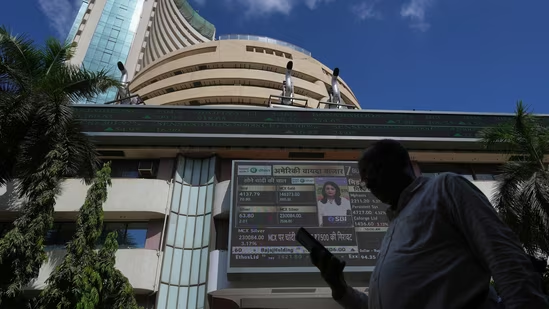
Indian stock markets witnessed one of the sharpest declines of the year as benchmark indices BSE Sensex and NSE Nifty50 plunged more than 2% in a single trading session. The sudden selloff erased nearly ₹8 lakh crore in investor wealth, leaving retail and institutional investors worried about the near-term outlook.
The broad-based market correction affected banking, IT, auto, metal, and energy stocks, while investor sentiment turned cautious amid rising global uncertainties. Here’s a closer look at what triggered the sharp fall and what investors should watch next.
Market Performance at a Glance
The benchmark indices ended the session with significant losses:
- BSE Sensex: Closed at 76,503.60, down 1,677 points (-2.15%)
- NSE Nifty50: Closed at 23,882.05, down 517 points (-2.12%)
- Investor Wealth Lost: Approximately ₹8 lakh crore
- Market Breadth: Selling pressure was visible across most sectors, with banking and financial stocks leading the decline.
The decline marked one of the steepest single-day corrections in recent months, reflecting heightened risk aversion among investors.
Top Reasons Behind Today’s Stock Market Crash
1. Rising Geopolitical Tensions
The biggest trigger behind today’s selloff was the renewed geopolitical uncertainty following reports that the truce between the United States and Iran had effectively ended. The development increased fears of prolonged conflict in the Middle East, prompting investors to move away from riskier assets like equities.
2. Surge in Crude Oil Prices
India imports a large portion of its crude oil requirements. Escalating tensions in oil-producing regions pushed global crude prices higher, raising concerns over inflation, increased import costs, and pressure on corporate earnings.
Higher oil prices generally impact transportation, manufacturing, aviation, logistics, and several consumer-facing sectors, making investors cautious.
3. Weak Global Market Sentiment
Global equity markets also traded lower as investors reacted to geopolitical developments and concerns over economic growth. Weak international cues spilt over into Indian markets, leading to broad-based selling across large-cap and mid-cap stocks.
4. Heavy Selling in Banking Stocks
Banking and financial stocks contributed significantly to the market decline. Several heavyweight stocks, including leading private banks and large-cap companies, came under pressure, dragging both the Sensex and Nifty lower.
Since financial stocks carry substantial weight in benchmark indices, even modest declines in these stocks can have a significant impact on the overall market.
5. Profit Booking After Recent Gains
Markets had rallied strongly over recent weeks, prompting many investors to book profits at higher levels. The negative global news acted as a catalyst for traders to reduce exposure, accelerating the selloff.
When profit booking coincides with weak global sentiment, market declines often become sharper due to increased volatility.
Which Sectors Were Hit the Hardest?
Selling pressure was widespread, but some sectors witnessed deeper declines than others:
- Banking & Financial Services
- Information Technology (IT)
- Auto
- Metals
- Energy
- Infrastructure
Defensive sectors such as FMCG and select pharmaceutical companies showed relatively better resilience, although they also ended lower.
What Should Investors Do Now?
Sharp market corrections can create uncertainty, but financial experts generally advise investors to avoid panic selling during periods of heightened volatility.
Long-term investors may consider:
- Staying invested according to their financial goals.
- Avoiding emotional investment decisions.
- Reviewing portfolio diversification.
- Monitoring crude oil prices and global geopolitical developments.
- Investing systematically through SIPs is aligned with their financial strategy.
Short-term market volatility is common, especially when global events influence investor sentiment.
Outlook for the Indian Stock Market
The near-term direction of Indian equities will largely depend on geopolitical developments, crude oil prices, foreign institutional investment flows, inflation expectations, and upcoming corporate earnings. Any easing of geopolitical tensions or stabilization in energy prices could help improve market sentiment.
While today’s decline erased nearly ₹8 lakh crore in investor wealth, market corrections are a normal part of investing. Investors should focus on long-term fundamentals rather than reacting solely to daily price movements. Keeping a disciplined investment approach remains one of the most effective ways to navigate volatile markets.