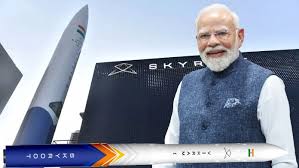
Event Overview
Prime Minister Narendra Modi virtually inaugurated Skyroot Aerospace’s Infinity Campus in Hyderabad on November 27, 2025, and unveiled Vikram-I, India’s first privately developed orbital launch vehicle capable of placing satellites into low Earth orbit. The 200,000 sq ft facility supports end-to-end rocket development and testing, with capacity for one orbital rocket per month. Modi praised the innovation, crediting space reforms and youth entrepreneurship for positioning India as a global space leader.
Vikram-I Specifications
Vikram-I, named after Dr. Vikram Sarabhai, stands 20 meters tall with 1.7m diameter, generating 1,200 kN thrust via carbon composite structure and four stages: three solid-fueled and one liquid. It enables multi-satellite launches in a single mission, with 24-hour assembly-to-launch turnaround from any site. Skyroot plans a 2026 maiden flight, building on their 2022 Vikram-S suborbital success.
Significance
This milestone boosts India’s private space sector amid over 300 startups, aligning with goals of 50 annual launches by 2030. Founded by ex-ISRO alumni, Skyroot targets the small-satellite market, enhancing commercial capabilities. The event underscores Atmanirbhar Bharat in space tech.
Skyroot Aerospace, founded in 2018 by Indian Institute of Science alumni, is India’s first fully private space startup developing orbital launch vehicles and rocket engines. Vikram-I rocket, unveiled by PM Modi, is built with advanced carbon composite materials ensuring strength and lightweight characteristics, which improve payload efficiency. The modular rocket design supports varying payload sizes and multi-satellite launches. The Infinity Campus in Hyderabad spans 1.78 acres with cutting-edge facilities including rocket testing and assembly lines designed for high-frequency launches.
Skyroot created Vikram-S, a smaller suborbital rocket, successfully demonstrating key technologies in prior testing. Vikram-I will cater to India’s booming small satellite sector, essential for telecom, earth observation, and defense. The government’s reforms under the Indian National Space Promotion and Authorization Center (IN-SPACe) and encouragement of private players have accelerated space innovation, allowing startups like Skyroot to compete globally. India’s goal of 50 launches annually by 2030 heavily depends on such private-public partnerships.
The announcement at Hyderabad generated strong enthusiasm for India’s growing role in the global space economy, attracting investor interest and boosting indigenous technology confidence. Skyroot aims for a maiden orbital flight by 2026. Beyond Vikram-I, they are developing advanced Vikram-II and Vikram-III rockets with greater payload capacities to expand market reach. This launch highlights India’s emerging ecosystem for commercial space ventures and strengthens Atmanirbhar Bharat visions in high tech domains.
Vikram-I Technical Specs
Vikram-I measures 20m tall with 1.7m diameter, using a four-stage system: three solid-fuel stages (Kalam-1200 for Stage 1 at 120-ton thrust, 10m carbon-fiber motor; Kalam-250 for Stage 2) and optional liquid Stage 4 with Raman engines for orbit adjustments. It lifts 290-480kg to 500km LEO/SSPO, supports multi-satellite rideshares, and features 24-hour turnaround with submerged nozzles for efficiency. Maiden flight targets early 2026 from Sriharikota.
Infinity Campus Details
The 200,000 sq ft Hyderabad facility enables end-to-end rocket production, testing one orbital vehicle monthly at Rs 1,000 crore investment. It includes MAX-Q HQ for operations and advanced assembly lines, boosting India’s private launch cadence.
Future Plans
Skyroot develops Vikram-II with cryogenic methalox engines for larger payloads and potential reusability, followed by Vikram-III for heavier satellites. Over 500 experts drive high-frequency launches amid 300+ startups, targeting global small-sat market.
PM Modi Speech Highlights
Modi hailed Gen-Z innovators, crediting space reforms for private breakthroughs and guaranteeing government support for entrepreneurs. He positioned Vikram-I as a milestone for India’s space leadership and Atmanirbhar Bharat.