Introduction
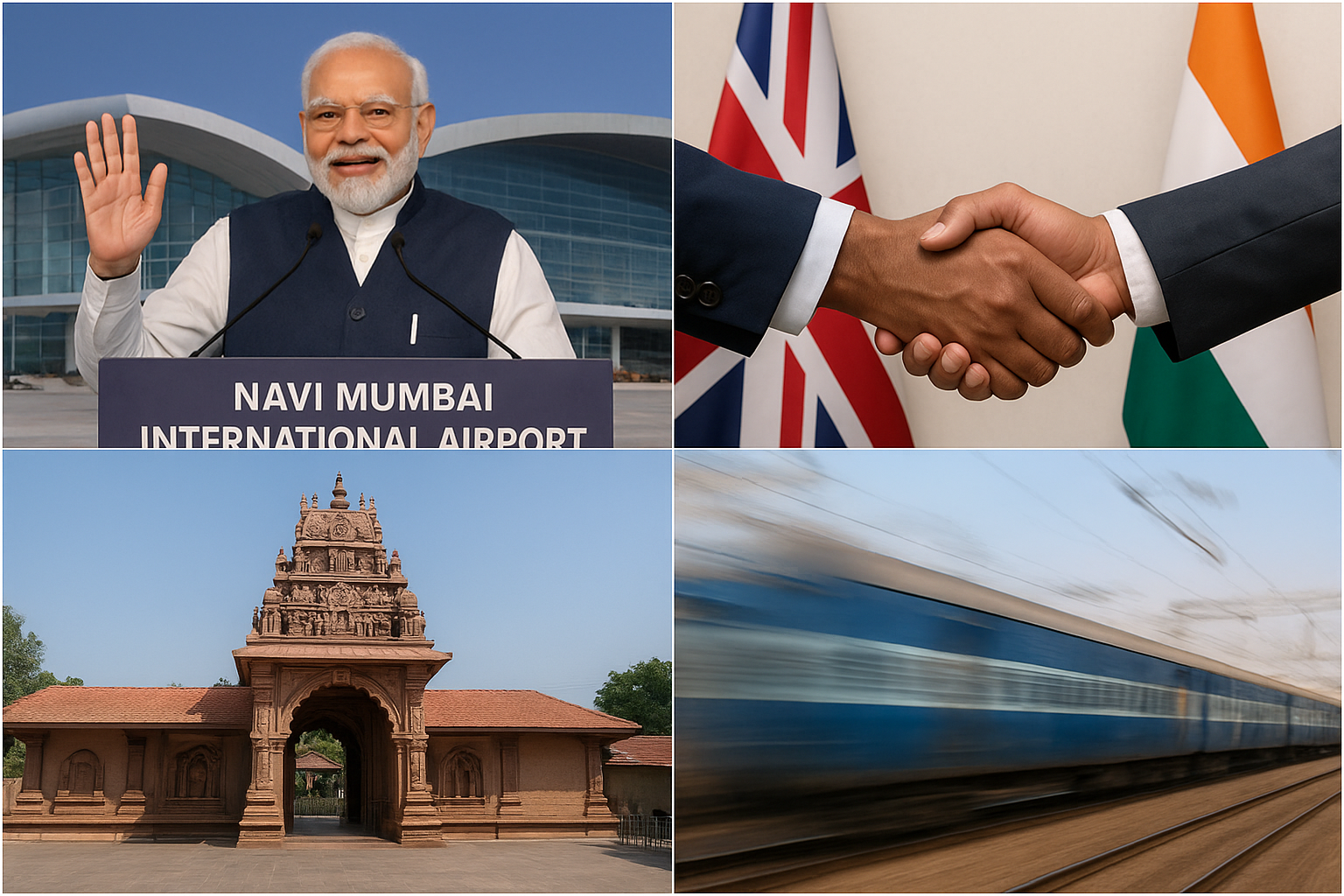
India’s news cycle this week has been a whirlwind — from grand infrastructure rollouts and bold international trade moves, to debates about religion, decency, and viral social media moments. In one sweep, PM Modi inaugurated the Navi Mumbai International Airport, a landmark UK-India trade deal is rewriting import tariffs, a woman was denied temple entry over her attire, and a passenger locked himself inside a train toilet for hours. Let’s unpack what each of these stories means — socially, economically, and culturally.
🚀 1. PM Modi Inaugurates Navi Mumbai International Airport (NMIA)
Prime Minister Narendra Modi officially inaugurated Phase 1 of the Navi Mumbai International Airport (NMIA) on October 8, 2025.
Key Highlights & Significance
-
The first phase was built at a cost of approx ₹19,650 crore and occupies 1,160 hectares.
-
Initially, the airport will handle around 20 million passengers annually, with future expansion planned to accommodate up to 90 million and 3.25 million tonnes of cargo.
-
The design draws inspiration from the lotus flower, with futuristic finishes and infrastructure including solar power generation, electric buses, and sustainable aviation fuel capacity.
-
Commercial operations—both domestic and international—are expected to begin by December 2025.
Strategic & Economic Impact
-
NMIA will ease congestion at Mumbai’s existing Chhatrapati Shivaji Maharaj International Airport and mark Mumbai as one of India’s few cities with multiple international airports.
-
Improved connectivity promises benefits for trade, tourism, and regional development, especially for Maharashtra’s hinterlands.
-
The airport’s PPP (public-private partnership) model, involving Adani Airports Holdings Limited (74%) and CIDCO (26%), underscores India’s emphasis on private capital for infrastructure.
Concerns & Caveats
-
Local activists have raised air safety concerns due to the presence of illegal slaughterhouses and mutton stalls within 3 km of the runway area — seen as potential hazards for bird strikes.
-
Infrastructure coordination (road, rail, and metro links) will be critical to make NMIA fully functional and accessible.
🇬🇧 2. UK-India Trade Deal: Whisky Tariffs & Beyond
In parallel with the domestic infrastructure story, India is also making waves internationally with its recent trade agreement with the United Kingdom.
What’s in the Deal
-
The UK-India Free Trade Agreement (FTA), signed in July 2025, promises to slash India’s import tariffs on several British goods — notably Scotch whisky.
-
Indian tariffs on Scotch whisky are set to fall from as high as 150% down to 75% immediately, with further cuts planned to 40% over ten years.
-
The deal also includes tariff reductions on cars, cosmetics, medical devices, and other goods, while 99% of Indian exports to the UK will become duty-free under this agreement.
-
During his trade mission to India, UK Prime Minister Keir Starmer emphasized that this FTA is the “best deal ever with India,” and that implementation should move “as soon as humanly possible.”
Implications & Reactions
-
For UK exporters: Scotch whisky brands like Johnnie Walker and Glenfiddich may see improved access and competitiveness in the Indian market.
-
For Indian consumers: Potential for lower prices on imported British goods over time.
-
Strategic angle: The deal also strengthens diplomatic and economic ties post-Brexit, helping the UK realign its trade relationships outside the EU.
-
Some questions remain: how India’s domestic industries will be affected, when tariffs will come into force, and whether non-tariff barriers (standards, logistics) may offset tariff gains.
🛕 3. Temple Dress Code Drama: Shorts Denial Sparks National Debate
A viral video captured a dramatic incident at a temple when a woman wearing shorts attempted entry and was denied. She confronted the priest and a police official, arguing her right to enter.
What Happened
-
The woman reportedly refused to remove or change her attire, insisting on her right to enter the place of worship.
-
The video shows heated exchanges; onlookers debated whether religious norms or individual rights should prevail.
-
Social media quickly picked up the case, dividing opinions. Some defended the temple’s dress code traditions; others saw it as a matter of gender equality and personal freedom.
Underlying Tensions
-
This incident touches on a deeper question: How do religious customs and modern notions of rights and expression coexist?
-
Temples across India often enforce dress codes for devotees (e.g., no shorts, sleeveless garments). These rules are sometimes unwritten but socially enforced.
-
The clash prompts debates on whether such norms should be adapted in today’s more pluralistic, gender-aware society.
🚂 4. Viral Shock: Passenger Locks Himself in Train Toilet for 6 Hours
In yet another bizarre viral moment, a passenger aboard an Indian Railways train locked himself inside a toilet for over six hours. The incident was caught on camera, sparking wild speculation and debate.
What Unfolded
-
The railway crew and other passengers tried repeatedly to open the locked door, even resorting to screwdrivers, before realising the passenger was inside intentionally.
-
At one point, the staff asked the passenger to unlock it himself; he eventually complied, stepped out, and was met by staff taking photos and asking questions.
-
Social media users speculated motive: evading ticket checking, intoxication, mental distress, or a dare.
Why the Viral Buzz?
-
The weirdness factor is high — people love to share odd, unpredictable moments.
-
It touches larger concerns: train safety, passenger dignity, how Indian Railways responds to passenger emergencies, and how quickly the system escalates or de-escalates such situations.
🧩 Pulling the Threads Together: What These Stories Tell Us
These four stories—while disparate—offer a snapshot of India in flux:
-
Ambition vs Execution: The airport inauguration shows India’s ambition in infrastructure, while trade deals show its diplomacy and economic confidence.
-
Tradition vs Modernity: The temple dress code clash underscores ongoing tensions between preserving religious norms and evolving social values.
-
Public & Private on Display: The viral toilet lock incident and temple denial both highlight how public behavior, social media, and norms collide in today’s India