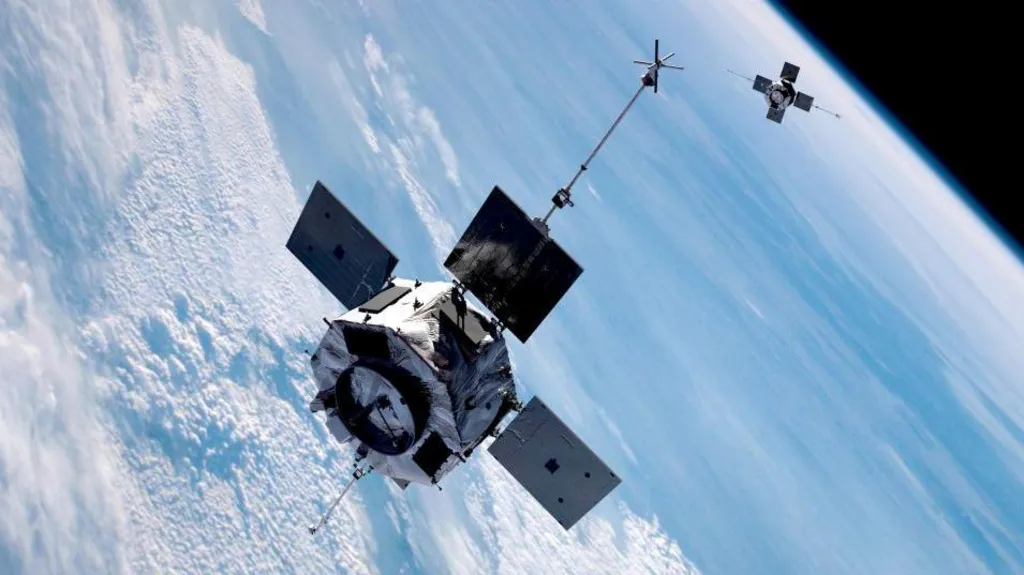
A spacecraft built by NASA weighing about 1,300 pounds (600 kg) has re-entered Earth’s atmosphere after spending nearly 14 years orbiting the planet. The spacecraft, known as Van Allen Probe A, was originally launched in 2012 to study the mysterious radiation belts that surround Earth.
Its return marks the end of an important scientific mission that helped researchers better understand space weather and the powerful radiation environment surrounding our planet.
What Was the Van Allen Probe Mission?
The Van Allen Probes mission was launched in August 2012 by NASA to investigate the Van Allen radiation belts, two doughnut-shaped regions of energetic particles trapped by Earth’s magnetic field.
These belts play a critical role in protecting Earth from harmful cosmic radiation and solar storms. Scientists wanted to understand how particles enter and leave these belts and how solar activity influences them.
The mission included two identical spacecraft, commonly known as Van Allen Probe A and Probe B. Although the mission was initially planned to last just two years, the probes remained operational for nearly seven years, providing groundbreaking discoveries and valuable scientific data.
Why the Spacecraft Returned to Earth
After completing its mission, Van Allen Probe A ran out of fuel and was eventually deactivated in 2019. Without active control, the spacecraft gradually lost altitude due to atmospheric drag.
Scientists originally predicted that the spacecraft would remain in orbit until 2034, but increased solar activity during the current solar cycle caused Earth’s atmosphere to expand slightly. This created more drag on the spacecraft, pulling it out of orbit years earlier than expected.
As the probe descended toward Earth, it eventually reached a point where it could no longer remain in orbit and began its final re-entry into the atmosphere.
What Happens During Spacecraft Re-Entry?
When spacecraft return to Earth’s atmosphere, they travel at extremely high speeds. The friction generated by atmospheric gases produces intense heat—often reaching thousands of degrees Celsius.
For most satellites and spacecraft, this heat causes them to break apart and burn up before reaching the ground. In the case of Van Allen Probe A, scientists expected the majority of the spacecraft to disintegrate during this fiery descent.
However, some stronger components, such as metal tanks or structural parts, can sometimes survive re-entry and fall to Earth as debris.
Is There Any Risk to People on Earth?
According to NASA and monitoring agencies, the risk to people on Earth from the spacecraft’s debris is extremely low.
Experts estimated the probability of someone being harmed by falling debris at about 1 in 4,200.
Several factors make the risk small:
-
Most of Earth’s surface is covered by oceans
-
Large regions of land are sparsely populated
-
Most of the spacecraft burns up before reaching the ground
In many cases, surviving fragments fall into remote ocean areas.
Major Discoveries from the Mission
Despite its relatively small size, Van Allen Probe A contributed enormously to space science. Over its years in orbit, the spacecraft provided scientists with valuable data about Earth’s radiation environment.
Some of the mission’s key discoveries include:
-
Evidence that electrons in radiation belts can accelerate close to the speed of light
-
Discovery of a temporary third radiation belt during periods of intense solar activity
-
Improved understanding of space weather events
These findings help scientists protect satellites, astronauts, and communication systems from radiation damage caused by solar storms.
What About the Second Probe?
The twin spacecraft, Van Allen Probe B, is still orbiting Earth. Scientists expect it to remain in space for several more years before eventually re-entering the atmosphere sometime in the 2030s.
Until then, researchers continue to analyze the massive amount of data collected during the mission.
Growing Concern About Space Debris
The return of Van Allen Probe A also highlights a growing challenge in space exploration: space debris.
Thousands of inactive satellites and spacecraft are currently orbiting Earth. When these objects reach the end of their missions, they eventually re-enter the atmosphere.
Space agencies worldwide, including NASA, are working on strategies to ensure satellites are safely removed from orbit to reduce risks and maintain sustainable space operations.
Conclusion
The re-entry of Van Allen Probe A marks the end of a successful scientific mission that expanded our understanding of Earth’s radiation environment and space weather.
Although the spacecraft’s return may sound dramatic, events like this are a normal part of the lifecycle of satellites and spacecraft. Most of the probe burned up harmlessly in the atmosphere, while the knowledge it generated continues to influence future space research and exploration.
As space missions grow more advanced, lessons learned from missions like the Van Allen Probes will help scientists better protect technology and astronauts operating in the challenging environment of space.