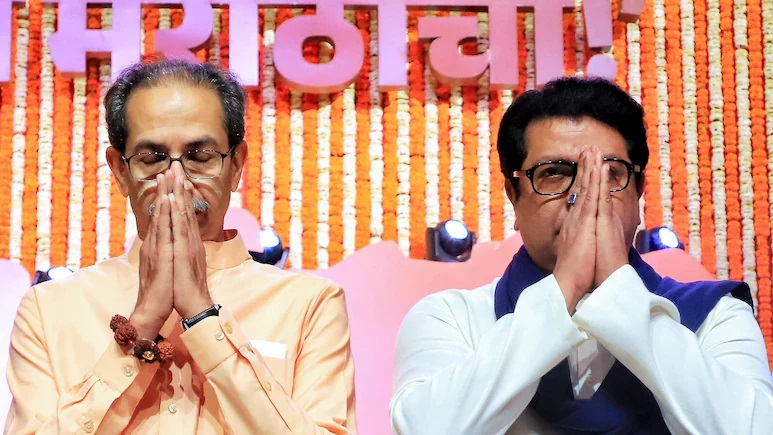
The much-anticipated reunion between Maharashtra’s two most prominent Thackeray cousins — Uddhav Thackeray and Raj Thackeray — was meant to be a political masterstroke. Instead, it appears to have backfired, potentially harming one cousin’s political standing more than the other. What looked like a potent attempt to consolidate the Marathi vote and reclaim the Shiv Sena legacy has struggled to translate into electoral success — and may have shifted the balance of power in the state’s politics once again.
A Reunion Steeped in History
The political rivalry between Uddhav Thackeray and Raj Thackeray stems from a split in Maharashtra’s most powerful regional outfit — the Shiv Sena. In 2005, Raj walked away from the undivided Shiv Sena after disputes over leadership succession, later forming his own party, the Maharashtra Navnirman Sena (MNS). For nearly two decades, the cousins have been bitter rivals, with their parties often competing for the same Marathi nationalist voter base.
In mid-2025, the two leaders publicly shook hands and embraced at a rally addressing opposition to the Maharashtra government’s controversial language policy — a move perceived as an imposition of Hindi as a compulsory language in schools. The rally was marked as a symbolic wish to put aside old grievances in the interest of championing Marathi identity and resisting what they described as cultural dilution.
From Hope to Hype — Then Disappointment
Political analysts had hoped the reunion would reshape Maharashtra’s civic electoral landscape. A united Thackeray front, it was speculated, could harness Marathi pride while drawing votes away from the ruling BJP–Shinde alliance. Newspapers reported that the newly reunited front might even isolate Congress from state politics by consolidating regional influence.
However, recent electoral developments tell a different story. In the ongoing Brihanmumbai Municipal Corporation (BMC) and other civic body elections, the rival Mahayuti alliance — comprising the BJP and Eknath Shinde’s faction of the Shiv Sena — appears to have maintained a strong grip on urban and Marathi heartland constituencies. Early exit polls and vote leads suggest Mahayuti is poised for dominance in major urban centres, including Mumbai and Pune, weakening the combined force of Shiv Sena (UBT) and MNS.
What was meant to be a strategic revival has instead underscored persistent weaknesses. Despite their public reconciliation, the two cousins have failed to fully integrate their respective parties’ grassroots machinery, vote banks, and strategic planning. Voters appear wary of the sudden unity, perceiving it as a convenience-driven alliance rather than a genuine ideological merger. This has diluted the anticipated “Marathi manoos” narrative that once secured strong support.
Who Lost More? The Politics Behind the Numbers
Although both leaders have suffered from the lacklustre electoral performance, Uddhav Thackeray appears to have absorbed more political damage. His Shiv Sena (UBT) — already weakened after the party split following Eknath Shinde’s rebellion in 2022 — had pinpointed the reunion as a vehicle for revival. For Uddhav, the alliance was as much about restoring political relevance as it was about cultural symbolism. The failure to convert this into electoral gains risks further erosion of his party’s base.
In contrast, Raj Thackeray — whose MNS has repeatedly struggled to win seats independently in recent years — had less to lose electorally. The party’s performance has waned significantly since its early promise, and its fusion with Shiv Sena (UBT) was seen more as a survival strategy than a rejuvenation. Consequently, its relative lack of expectations meant that underperformance does not appear as dramatic when compared with Shiv Sena (UBT).
Political pundits note that Raj’s brand of Marathi nationalism, though potent in rhetoric, has not translated into resilient organisational strength. Meanwhile, Uddhav’s challenges are compounded by the perception of indecision — moving from alliance with Congress and NCP to an attempted regional consolidation — which has blurred his core political identity.
What’s Next for Maharashtra Politics?
Maharashtra’s political trajectory remains dynamic. With the Mahayuti alliance performing strongly electorally, regional actors like the Thackeray cousins might be forced to recalibrate strategies. Congress and NCP, although weakened, could play kingmaker roles if electoral math shifts in future polls. Meanwhile, grassroots sentiment around linguistic identity and regional pride continues to influence voter behaviour — but whether it translates into political power remains uncertain.
In essence, the failed Thackeray reunion illustrates that symbolic gestures and historical legacy — while powerful — must be matched with robust organisational strategy, clear messaging, and voter trust. Without that foundation, even the most iconic political names can struggle to sustain influence in the competitive terrain of Maharashtra politics.