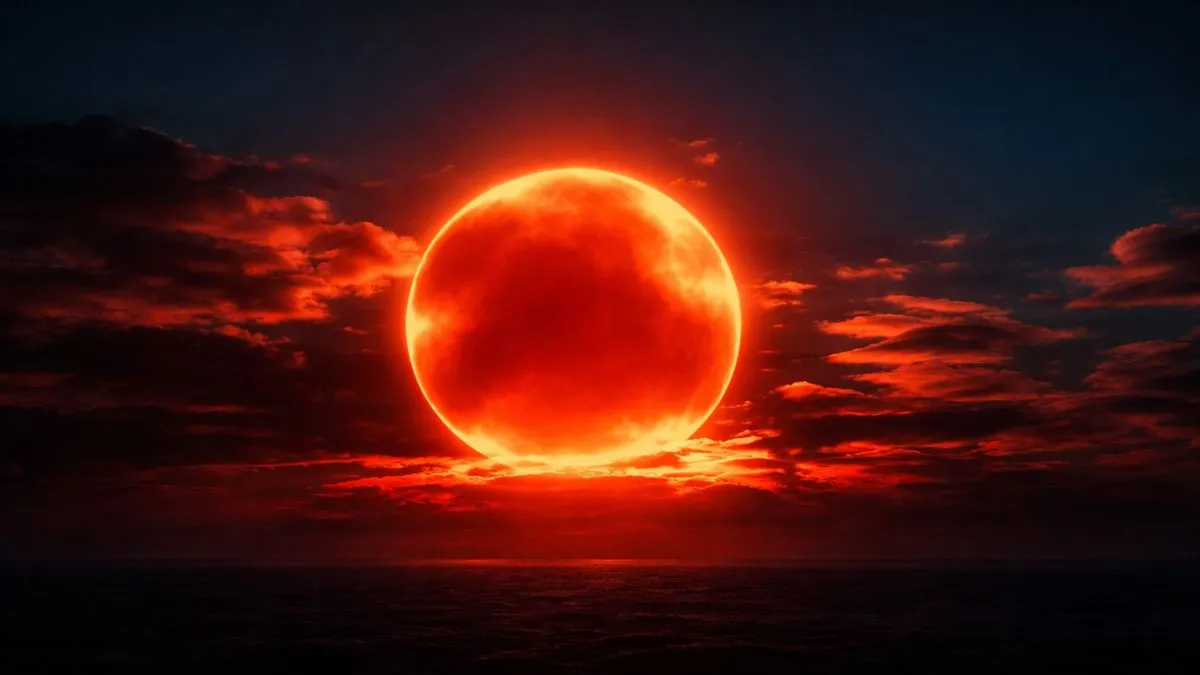
The first major astronomical event of 2026 is set to captivate skywatchers and science enthusiasts worldwide. On February 17, 2026, Earth will witness a rare and dramatic annular solar eclipse, popularly known as the “Ring of Fire.” This celestial spectacle occurs when the Moon passes directly between the Earth and the Sun without fully obscuring the Sun’s disk, leaving a brilliant fiery ring visible in the sky.
⭐ What Is an Annular Solar Eclipse?
A solar eclipse happens when the Moon moves between Earth and the Sun, casting a shadow that partially or fully blocks the Sun’s light. In an annular eclipse, the Moon appears slightly smaller than the Sun due to its position in its elliptical orbit, so it does not completely cover the Sun’s disk. Instead, the Sun forms a luminous ring around the Moon’s silhouette—hence the dramatic “Ring of Fire.”
Astronomers sometimes refer to this phase as annularity, drawn from the Latin word annulus, meaning “ring.” During this moment, the sky does not go completely dark like a total eclipse, but the light dims, and shadows become sharper, creating a special mid-day twilight effect.
📅 Eclipse Date, Duration & Path
The annular solar eclipse will take place on:
-
Date: Tuesday, February 17, 2026
-
Peak annularity: For about 2 minutes and 20 seconds
-
Type: Annular solar eclipse (“Ring of Fire”)
However, this dazzling ring effect is visible only along a narrow path of annularity that runs mainly over Antarctica—one of the most remote and inaccessible regions on Earth. Only a small number of research stations and personnel in Antarctica will witness the full ring effect directly. Outside this corridor, a partial eclipse will be visible across parts of southern Africa, South America and the surrounding oceans.
🛰️ Can You See It in India?
Astronomy enthusiasts in India might be disappointed to know that this eclipse will not be visible from anywhere in the country. According to timing data converted to Indian Standard Time (IST), the eclipse occurs between 3:26 PM and 7:57 PM IST, but the Sun will be positioned such that the eclipse cannot be seen from India. As a result, traditional practices like Sutak Kaal—a period observed before an eclipse—are generally not considered valid in India for this event.
Despite its invisibility from Indian skies, people can still enjoy the eclipse through live online streams provided by space agencies and astronomy platforms. These streamings offer a safe and breathtaking way to witness the cosmic spectacle in real time.
🔭 How to Watch Safely
Even if you were within the visibility range, it’s crucial to view the sun using proper solar eclipse glasses or certified solar viewers. Looking directly at the Sun without protection—even during an eclipse—can cause permanent eye damage. Ordinary sunglasses are not sufficient to protect your eyes from intense solar radiation.
Live streams and online coverage offer the safest way to observe the eclipse from regions where physical viewing isn’t possible. Many astronomy websites and scientific organisations will broadcast the event for free.
🌎 Why This Eclipse Matters
Annular eclipses like the February 17 event are scientifically significant. They provide opportunities for researchers to study the Sun’s atmosphere, refine orbital models, and engage the public in space science. They also remind us of the dynamic dance between Earth’s celestial neighbours.
For skywatchers in regions where a partial eclipse will be visible, the Sun will appear as if a “bite” has been taken out of it—a compelling sight even without the full ring effect.
👁️ What to Expect Around the World
🌍 Antarctica: Best and full view of the “Ring of Fire.”
🌍 Southern Africa & South America: Partial eclipse with significant solar coverage.
🌍 India & most of Asia: No visible eclipse, but live streams available.
While Indians won’t see the eclipse in the sky, the event continues to inspire astronomers and eclipse chasers globally as one of the first major celestial events of 2026.
🔁 Final Thoughts
The February 17, 2026, annular solar eclipse is a rare astronomical event that highlights the beauty and precision of celestial mechanics. Whether you’re observing it online or planning future eclipse expeditions, this “Ring of Fire” reminds us of the wonders of the universe.
Stay tuned for expert live coverage and detailed guides as the event approaches!