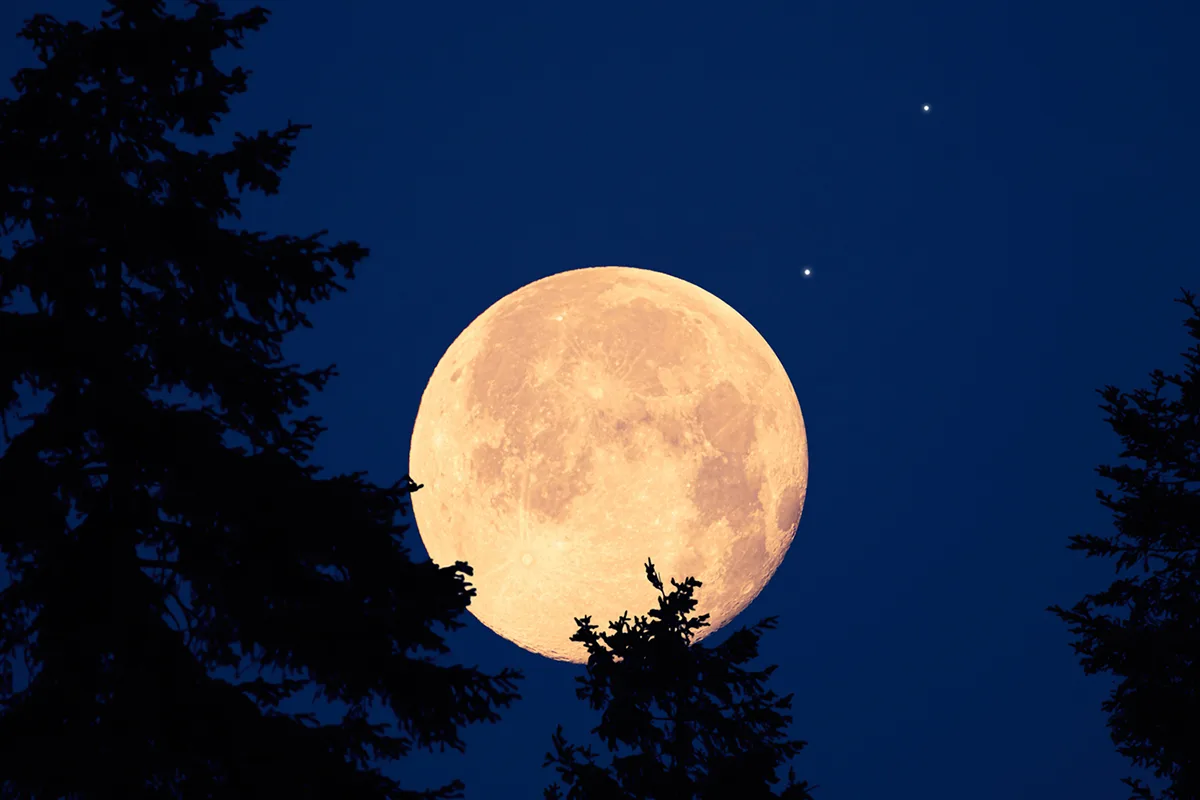
Skywatchers are in for a special treat this weekend as a rare celestial event known as a Blue Micromoon lights up the night sky. While the term may sound like something out of science fiction, a Blue Micromoon is a real astronomical phenomenon that combines two separate lunar events into one unusual spectacle.
Despite its name, the moon will not actually appear blue, nor will it look dramatically smaller than usual. However, this rare occurrence offers astronomy enthusiasts and casual stargazers a unique opportunity to observe one of the less common full moon events.
What Is a Blue Micromoon?
A Blue Micromoon occurs when a Blue Moon coincides with a Micromoon.
A Blue Moon is commonly defined as the second full moon occurring within a single calendar month. In some traditional astronomical definitions, it can also refer to the third full moon in a season containing four full moons.
A Micromoon, on the other hand, happens when a full moon occurs near the point in the moon’s orbit where it is farthest from Earth, known as apogee. Because the moon is farther away than usual, it appears slightly smaller and dimmer compared to a typical full moon.
When these two events happen at the same time, astronomers refer to the result as a Blue Micromoon.
Why Isn’t the Moon Actually Blue?
One of the biggest misconceptions surrounding a Blue Moon is that it changes colour. In reality, the term “blue” has nothing to do with the moon’s appearance.
The phrase originates from historical calendar calculations and has become associated with rare events, giving rise to the popular expression, “once in a blue moon.”
Under very unusual atmospheric conditions—such as after volcanic eruptions or large forest fires—the moon can appear bluish due to particles suspended in the atmosphere. However, these conditions are unrelated to the Blue Moon designation.
Why Does a Micromoon Look Smaller?
The moon follows an elliptical orbit around Earth rather than a perfect circle. This means its distance from Earth changes throughout the month.
At apogee, the moon can be tens of thousands of kilometres farther away than it is at perigee, its closest point to Earth. During a Micromoon, the lunar disk can appear up to 14% smaller and around 30% dimmer than a Supermoon.
Most casual observers may not immediately notice the size difference without comparing photographs, but astronomers and experienced skywatchers often appreciate the subtle change.
When Is the Best Time to See the Blue Micromoon?
The best time to view the Blue Micromoon is during the evening hours immediately after moonrise this weekend.
As the moon rises above the horizon, it often appears larger due to a visual phenomenon known as the moon illusion. Although the moon’s actual size does not change, surrounding objects such as buildings, trees, and mountains create the impression that it is much larger.
For the most impressive view:
- Check local moonrise times for your area.
- Find a location with a clear eastern horizon.
- Avoid areas with excessive light pollution.
- Use binoculars or a small telescope for enhanced detail.
- Allow your eyes time to adjust to darker conditions.
Even though the moon will technically be a Micromoon, viewing it near the horizon can create a stunning visual effect.
Why Is This Event Rare?
Blue Moons occur only every few years, while Micromoons happen several times annually. The overlap between these two events is considerably less common, making a Blue Micromoon an interesting occurrence for astronomy enthusiasts.
The event serves as a reminder of the dynamic relationship between Earth and its natural satellite, showcasing how orbital mechanics can create unique and memorable celestial displays.
Tips for Photographing the Blue Micromoon
If you plan to capture the event, consider these photography tips:
- Use a tripod to stabilize your camera.
- Shoot during moonrise for dramatic foreground compositions.
- Use manual focus for sharper lunar details.
- Experiment with different exposure settings.
- Include landmarks or landscapes to create scale and visual interest.
Smartphone users can also achieve impressive results by using night mode features and zoom lenses where available.
Final Thoughts
The Blue Micromoon may not appear blue and might not seem noticeably tiny, but it remains a fascinating astronomical event worth observing. Whether you’re an experienced stargazer or simply enjoy looking up at the night sky, this weekend’s lunar display offers a chance to witness a relatively uncommon combination of celestial events.
Grab a pair of binoculars, find a dark viewing location, and take a few moments to appreciate one of nature’s most captivating spectacles. Events like the Blue Micromoon remind us that even familiar objects like the moon can still surprise us with their cosmic complexity.